
Filling options at i-Smile
Composite (tooth-coloured) fillings are the standard choice for most cavities today. The material is a resin packed with fine glass particles, placed in thin layers and hardened with a blue light. It bonds to the tooth, so less healthy tooth needs to be cut away than with old silver fillings, and it comes in shades that match your enamel. It suits front and back teeth, and also repairs chips and worn edges.
Ceramic inlays and onlays are for larger cavities in back teeth, where a big composite filling would be weak but the tooth is not damaged enough to need a full crown. The restoration is made outside the mouth from a scan or impression of the prepared tooth, then bonded in at a second visit. It is stronger, wears like enamel and does not stain.
Glass ionomer fillings release fluoride and bond well to damp surfaces, which makes them useful for cavities near the gum line, for milk teeth and as a base under a composite. They are not as strong or as polishable as composite, so they are chosen for specific situations.
Silver amalgam fillings, which many adults have from years ago, are durable and considered safe by dental authorities. If yours are sound, they are best left alone. If one is cracked, leaking or has decay underneath, it is replaced, usually with composite.
What getting a filling actually feels like
Shallow cavities in enamel can often be treated without any anaesthesia; you feel vibration and coolness from the water spray, nothing more. For deeper cavities we numb the tooth. The injection is a brief sting, and the lip and cheek on that side feel thick for two to three hours afterwards.
The decay is removed with a small drill, which is the noisy part and takes a few minutes. The cavity is washed, dried and etched, a bonding agent is applied, and the composite is placed in layers, each set with a blue light for about 20 seconds. We then check your bite with marking paper, adjust any high spot, and polish the surface. Start to finish is 30 to 45 minutes for one tooth.
You can eat as soon as the numbness wears off. Some sensitivity to cold for a few days or weeks is normal and fades as the tooth settles. If a filling feels high when you bite, tell us; a two-minute adjustment fixes it and prevents soreness.
Why patients choose i-Smile for fillings
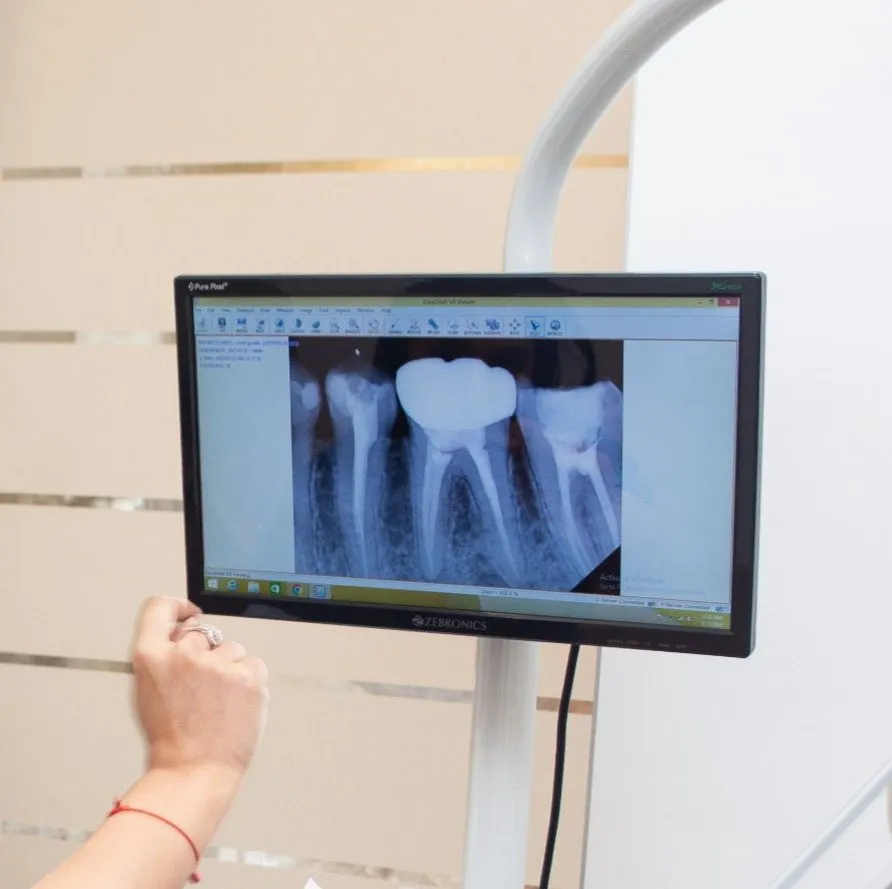
- Digital X-rays find cavities between the teeth that are invisible in a mirror, at far lower radiation than film.
- You see the cavity on the intraoral camera before we start, and the finished filling afterwards.
- Dr. Upasana does the work herself, and if the decay turns out to be deeper than expected, she explains the options before continuing rather than surprising you with a root canal.
- Single-visit treatment. Most fillings are completed in one appointment, and the clinic is open 9 am to 9 pm, Monday to Saturday.
- Sterilisation. Every instrument is autoclaved after every patient.
- Rated 5.0 on Practo from over 700 reviews, and 4.9 on Google.
Making a filling last
A composite filling lasts five to ten years on average, and often longer. What shortens that is decay starting again at the edge, or the filling chipping under a heavy bite.
- Brush twice a day with a fluoride toothpaste and clean between the teeth daily. The margin where filling meets tooth is where new decay starts.
- Avoid chewing ice, pen caps or very hard sweets on a filled tooth.
- If you grind your teeth at night, a night guard protects fillings as well as enamel.
- Keep six-monthly check-ups. A small crack or worn edge can be repaired; a filling that has failed unnoticed often ends in a root canal.
- Cut down on sugary snacks and drinks between meals. It is the frequency, more than the quantity, that drives decay.
What changes the price
- Size and depth of the cavity. A composite filling is ₹2,500 per tooth; a very large cavity that rebuilds two or three surfaces may be better served by an inlay or onlay.
- Front or back tooth. Front teeth need more shade layering and shaping to look natural.
- Composite or ceramic. A ceramic inlay or onlay from ₹10,000 costs more because it is made outside the mouth and needs two visits, but it is the stronger option for a large cavity in a molar.
- Additional steps. A protective liner over a deep cavity close to the nerve, or removing an old filling with decay underneath, adds a little time and cost.
- Number of teeth. Each tooth is quoted separately after the examination and X-ray.
The ₹350 consultation fee is adjusted against treatment on the same visit.