How whitening actually works
Stains from food, drink and tobacco do not just sit on the surface; over the years they soak into the microscopic structure of enamel. Whitening gels contain hydrogen or carbamide peroxide, which releases oxygen molecules that break these stain molecules into smaller, colourless pieces. The enamel is not bleached away or coated; the colour trapped inside it is dismantled.
This is why professional whitening changes the shade of the tooth while whitening toothpaste only polishes the surface. It is also why whitening does nothing to crowns, veneers or fillings, which have no stain to dismantle.
In-clinic or take-home?
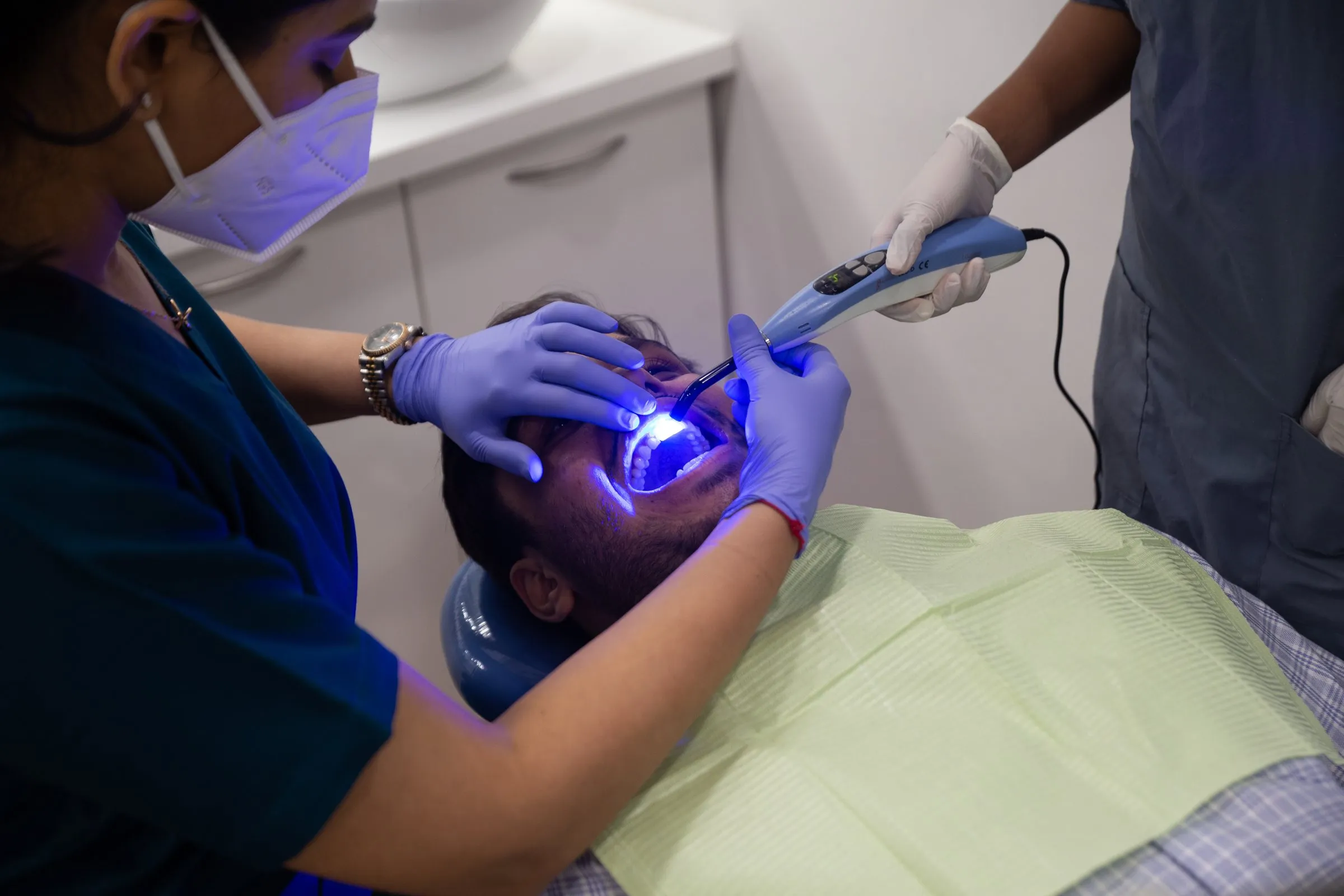
In-clinic whitening uses a stronger gel with the gums protected, so it can do in 90 minutes what a home kit does over two weeks. It suits people who want a result before an event, or who would rather not manage trays at home.
Take-home whitening uses trays moulded to your teeth and a milder gel worn for an hour or overnight for 10 to 14 days. The result is slightly gentler on sensitive teeth, and the trays remain useful for years as a touch-up tool.
Many patients do both: in-clinic for the jump, trays to hold the shade. Both are priced on the cost table above.
What the visit feels like
After the cleaning, a cheek retractor keeps your lips out of the way and the gum barrier is applied; it feels like a thin plastic film. The gel is painted on and you relax for 15 minutes at a time, watching something on your phone. Between cycles the gel is suctioned off and reapplied. Some people feel a few brief cold zings; most feel nothing. The whole visit is under an hour and a half, and you see the difference in the mirror before you leave.
Why patients choose i-Smile for whitening
- Examination first. Cavities, cracks and gum inflammation are found and treated before whitening, so there are no surprises and no unnecessary sensitivity.
- Cleaning included. Scaling and polishing are part of the in-clinic price, not an add-on.
- Honest expectations. If your stain type will not respond, or if a single dark tooth needs a different approach, you will be told at the consultation.
- Desensitising as standard, before and after, for comfortable treatment.
- Evening slots so you can whiten after work without taking leave.
Keeping teeth white
For 48 hours after treatment, stick to pale foods and drinks: milk, curd, rice, chicken, white bread, water. After that, rinse with water after tea or coffee, avoid tobacco and paan, and brush twice daily with a non-abrasive toothpaste. A six-monthly cleaning removes the surface stain that builds between sessions. Use your take-home trays for a night or two whenever the shade drifts.
What changes the price
- In-clinic or take-home, or both together.
- Number of sessions. Heavily stained teeth occasionally need a second in-clinic session.
- Preparatory work, such as fillings or gum treatment, quoted separately.
- Internal bleaching of a single root-canal-treated tooth is priced on its own.