
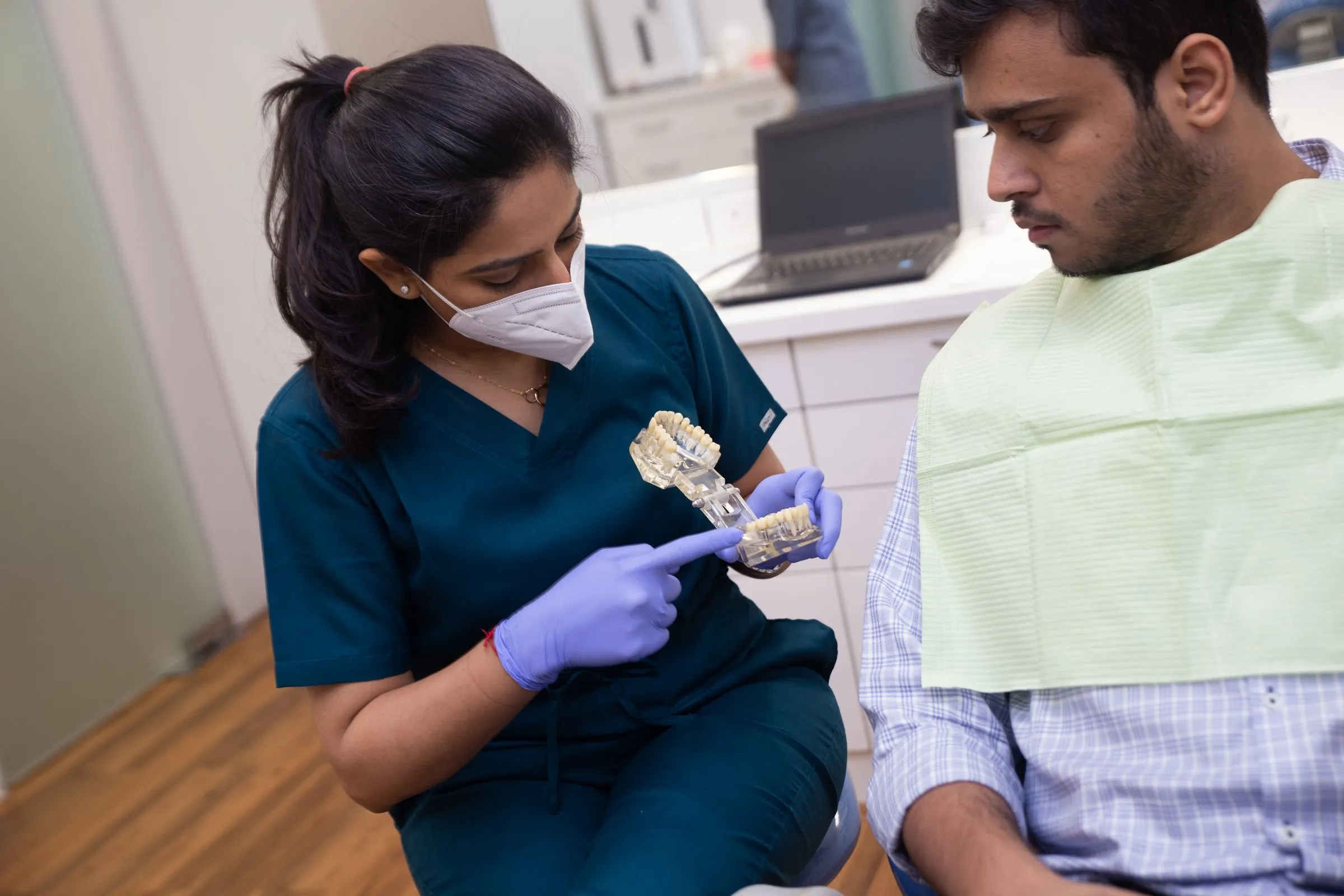
Composite or porcelain?
Composite veneers are sculpted directly onto your teeth from tooth-coloured resin, shaped by hand and hardened with a light. Everything happens in one visit, usually an hour or so for four to six teeth. They cost a fraction of porcelain, need little or no tooth preparation, and are easy to repair. The trade-offs are a shorter life, a slightly less glassy finish, and a tendency to pick up stains over time.
Porcelain veneers, including the E-max lithium disilicate type we use most, are made in a laboratory from an impression or scan of your prepared teeth. Porcelain reflects light the way enamel does, holds its colour, and resists stains. They take two to three visits and cost more, but last roughly twice as long.
A good rule of thumb: composite for a single chipped tooth, for a younger patient, or when budget is tight; porcelain for a full smile makeover meant to last a decade or more.
What treatment feels like
The consultation is mostly talking and photographs. Bring pictures of smiles you like and of your own smile from years ago if it has changed.
The mock-up visit is the fun part. A temporary material is pressed over your unprepared teeth in the planned shape, and you look in the mirror, take photos, and go home with it for a day if you like. Changes are easy at this stage. Once you approve, the laboratory copies that design exactly.
Preparation and bonding visits feel like a long, gentle filling appointment. There is polishing, some rinsing, a brief taste of the bonding agent, and a bright blue light. You leave with a smile that looks finished.
Why patients choose i-Smile for veneers
- Trial smile before commitment. You never approve a design on a screen alone; you see it on your own teeth.
- Conservative preparation. Dr. Upasana removes the minimum enamel needed for the veneer to look natural, and often none for composite.
- Honest advice on alternatives. If whitening or a short aligner course will get you most of the way for less, you will hear it first.
- Matching, not just white. Veneers are shaded to sit naturally with your other teeth and your complexion, not a single flat white.
- Care included. A two-week review, a polish at your six-monthly check-up, and a night guard recommendation if you grind.
Caring for veneers
Brush and floss as you would natural teeth, with a non-abrasive toothpaste. Avoid using your front teeth to bite through very hard foods such as raw carrots or hard crusts; cut them instead. If you clench or grind at night, wear the night guard we make for you; it is the single best way to make porcelain last. Come for a check-up every six months so small chips can be polished before they grow.
What changes the price
- Material. Porcelain and E-max cost more than composite.
- Number of teeth. Six to eight for a full smile; one or two for a single repair.
- Design work. A full digital smile design and mock-up is included for porcelain cases.
- Preparatory treatment. Whitening, a cleaning or gum contouring before veneers are quoted separately.
- Night guard, recommended for grinders.