
What gum treatment involves
Gum disease begins quietly. Plaque that is not brushed away hardens into tartar, the gum around it becomes inflamed and bleeds, and if nothing is done the bone that holds the teeth slowly dissolves. The early stage, gingivitis, is fully reversible. The later stage, periodontitis, can be stopped, but the bone that has gone does not grow back on its own. Treatment at i-Smile is matched to the stage.
Scaling and polishing is enough for gingivitis. Tartar is removed from above and just below the gum line in a single visit, and with better brushing the gums usually stop bleeding within a fortnight.
Deep cleaning, or scaling and root planing, is the main treatment for periodontitis. Under local anaesthesia, deposits are cleaned out of the pockets that have formed between the gum and the root, and the root surface is smoothed so the gum can reattach. We usually treat half the mouth per visit.
Flap surgery is for pockets that stay deeper than 5 mm after deep cleaning. The gum is lifted back under local anaesthesia so the root and bone can be cleaned directly, then stitched into place. One quadrant is done per visit. In some cases a bone graft can be placed at the same time.
Laser gum depigmentation is a cosmetic procedure for gums that are naturally dark rather than diseased. It is separate from gum disease treatment and is quoted on its own.
Maintenance is the part patients underestimate. Gum disease is a chronic condition, a little like blood pressure. Cleanings every three to six months are what keep it from returning.
What treatment actually feels like
Gum charting, where each pocket is measured with a fine probe, feels like light pressing and takes about ten minutes. Where the gums are inflamed there may be some bleeding, which is information for us rather than a problem.
Deep cleaning is done with the area numbed, so you feel vibration and water spray from the ultrasonic scaler and pressure from the hand instruments, but not pain. Sessions last 45 to 60 minutes. Afterwards the gums are tender for a day or two, and the teeth may feel sensitive to cold for a week or so as the swollen gum shrinks back and exposes a little root. Warm salt-water rinses and a sensitivity toothpaste help.
Flap surgery is more involved but not dramatic. The area is numb throughout, the visit takes about an hour for a quadrant, and you leave with a few stitches that come out after seven to ten days. Expect soreness and mild swelling for a few days, managed with ordinary painkillers and a soft diet.
Why patients choose i-Smile for gum treatment
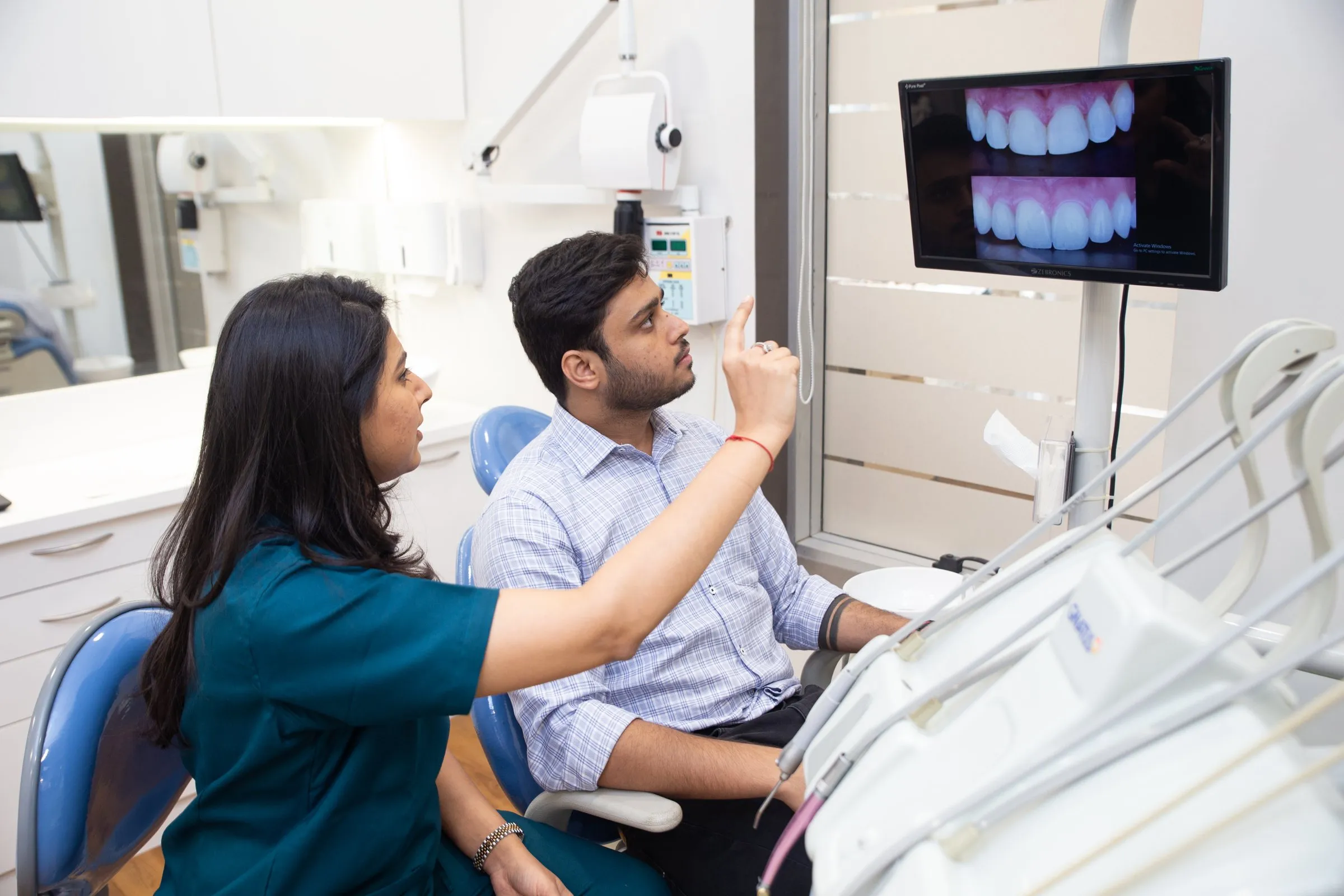
- We show you the problem. The intraoral camera lets you see the deposits, the bleeding points and the receded areas on screen, so you understand why treatment is being suggested and what has changed at the review visit.
- Digital X-rays with far lower radiation than film show how much bone remains around each tooth, which decides whether deep cleaning is enough or surgery is needed.
- Dr. Upasana does the treatment herself, from the first charting to the maintenance visits, so nothing is lost between people.
- Honest staging. If a tooth has too little bone to be worth saving, we say so and talk about replacement rather than treating it for the sake of it.
- Evening and Saturday hours. The clinic is open 9 am to 9 pm, Monday to Saturday, so an hour-long deep cleaning session fits after work.
- Sterilisation you can rely on. Every instrument is autoclaved after every patient.
Keeping your gums healthy afterwards
- Brush twice a day with a soft brush, angling the bristles towards the gum line. Two minutes, gently. Hard scrubbing wears the gum away.
- Clean between the teeth once a day. Interdental brushes work better than floss where gums have receded and gaps have opened.
- Do not stop brushing an area because it bleeds. Bleeding means it needs more cleaning, not less. It should reduce within a week or two.
- Come for maintenance cleanings at the interval we suggest, usually every three months in the first year and every six months once things are stable.
- If you smoke, cutting down or stopping makes a measurable difference to healing. If you have diabetes, keeping blood sugar controlled does too.
What changes the price
- Stage of disease. Gingivitis needs only a routine cleaning from ₹2,000. Periodontitis needs deep cleaning at ₹3,500 for the full mouth.
- Whether surgery is needed. Flap surgery is ₹5,000 per quadrant, and only the quadrants with deep pockets are treated.
- Bone grafts or membranes, if placed during surgery, are quoted separately.
- Number of visits. Deep cleaning in two halves and the review are part of the quote; maintenance cleanings afterwards are charged as routine cleanings.
- Laser depigmentation at ₹10,000 is cosmetic and separate from disease treatment.
The ₹350 consultation fee is adjusted against treatment on the same visit, and you get an itemised quote before anything starts.